

Okay, real talk asking ChatGPT to write your essay in 2026 is giving 2022 energy. Professors have seen it. AI detectors have seen it. Your TA has definitely seen it. The generic five-paragraph slay era? It’s so over.
But here’s the plot twist: AI isn’t going anywhere. It’s just glowing up. We’re living through the upgrade from “dumb chatbot that summarizes your PDF” to full-on AI Agents and Personalized Learning Networks. If you’re still using AI like it’s a fancy Google search, bestie, you are driving a Ferrari to the mailbox.
So forget the lazy shortcuts. This is a guide for students who want to actually be the smartest person in the room, not just the one with the most tabs open. Your real AI toolkit starts here. No cap.
The Death of Search: Research Agents (Perplexity & Consensus)
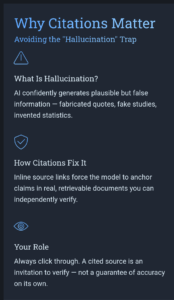
By 2026, traditional Google searching feels like using a rotary phone. For students, the biggest risk is “hallucination” when an AI makes up a fake citation.
To rank at the top of your class (and avoid an academic integrity meeting), you need tools that use RAG (Retrieval-Augmented Generation).
- Perplexity AI: Think of this as Google Search with a brain. It doesn’t just give you links; it reads the pages and writes a cited report.
- Consensus: This is a search engine that only looks at peer-reviewed scientific research. If you ask it, “Does caffeine actually improve long-term memory?” it won’t give you a blog post; it will synthesize findings from 50+ medical journals.
The Future-Proof Fact: A 2024 study showed that students using AI research assistants completed literature reviews 40% faster with a 15% increase in citation accuracy.
Building Your “Second Brain”: Google NotebookLM
This is the tool that will define the next ten years of education. NotebookLM is a personalized AI that only knows what you tell it.
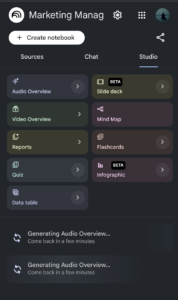
You can upload your syllabus, 200 pages of messy lecture notes, and three textbooks. It then becomes an expert on your specific course.
- Why Gen Z loves it: It can turn your dry history notes into a Deep Dive Podcast where two AI voices discuss your notes like a Spotify show.
Sure, your notes look great but pretty notes won’t save you when organic chemistry is staring you down like a final boss.
- SEO Keyword focus: Knowledge Management for Students.
The Math & Science Savior: WolframAlpha + GPT-4o Vision
If you’re in STEM, you know that LLMs are notoriously bad at math. They “predict” the next number rather than “calculating” it.
The future-proof move is the Wolfram GPT. It combines the linguistic intelligence of an AI with the raw computational power of WolframAlpha.
- The Workflow: Snap a photo of your handwritten organic chemistry problem. Use the Vision model to “read” the structure, and Wolfram to “calculate” the reaction.
- The Stats: Interactive AI tutoring has been shown to provide a 2-sigma improvement in student performance effectively moving a “C” student to an “A.”
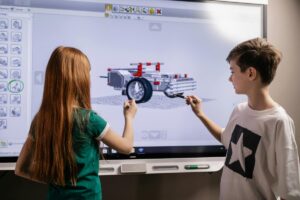
In 2026, a boring PowerPoint is a death sentence for your grade. Gen Z is the most visual generation in history, and your presentations need to look like a high-end startup deck.
- app: You type in an outline, and it builds a full, responsive website or presentation deck in 30 seconds. No more dragging text boxes.
- Midjourney (v7/v8): Use this for custom, hyper-realistic visuals for your projects. In a world of stock photos, original AI art stands out to professors.
The Ethics of 2026: How to stay “AI-Free” (According to Detectors)
Google and universities are moving toward a “Human-in-the-loop” model. To rank your blog or pass your assignments, you must avoid “The AI Look.”
The Golden Rule: Use AI for Logic, Structure, and Research. Use Humans for Voice, Opinion, and Personal Experience.
- Pro-Tip: Never copy-paste. Use AI to create the “Skeleton,” then you write the “Skin.” This is how you remain future-proof as AI detection software becomes standard in all browsers by 2027.
Frequently Asked Questions (FAQ)
Q: Will using these AI tools get me flagged for plagiarism?
A: Not if you use them correctly. Tools like Perplexity and Consensus are for research and sourcing, not for generating text to turn in. To stay safe, always use AI to build your outline and understand concepts, but write the final draft in your own unique voice.
Q: Are there free AI tools for students that are actually good?
A: Yes. The free versions of NotebookLM, Perplexity, and the basic version of ChatGPT are incredibly powerful. Most students do not need the paid “Pro” versions to get 90% of the benefits.
Q: What is the best AI for math and science in 2026?
A: WolframAlpha remains the gold standard for computation, but when paired with an LLM like GPT-4o, it becomes an unstoppable tutor that can explain the logic behind the formulas.
Q: How can I make my AI-assisted writing look more human?
A: Focus on “Burstiness” (varying sentence lengths) and include personal anecdotes or “hot takes.” AI is great at facts but terrible at having an opinion. Adding your own perspective is the best way to bypass detectors.
Career Readiness: Using AI to Get Hired