


It’s 7 p.m. on a Sunday. You have 100 unread emails, a calendar that looks like a game of Tetris, and you feel that familiar low-grade dread setting in. The Sunday Scaries aren’t about tomorrow’s workload, they’re a symptom of a broken operating system.
The expert of no productivity will tell you that your to-do list is a leftover from the 1990s. It was created for a world in which work had boundaries, assignments were limited, inboxes closed at five, and “urgent” meant a fax was coming in. That world is gone. Your list hasn’t caught up.
The highest-performing people I know don’t manage their time. They create systems that automatically make wise choices. Their AI prioritizes their emails instead of checking them. Their AI negotiates the time; they don’t set up meetings. The cognitive load gets offloaded. The focus stays on the work that actually moves the needle.
That shift is no longer a luxury for the elite. In 2026, a new class of AI scheduling assistants and time management tools has made it accessible to anyone willing to stop grinding and start engineering their workflow.

Quick Look: Key Takeaways for the Busy Professional
- The “Work About Work” Cure: 60% of our day is spent on admin; AI can reduce this to 10%.
- Dynamic Scheduling: Moving from “Static Calendars” to AI-driven algorithms like Motion.
- Research Grounding: Using Perplexity and Consensus to make data-driven decisions in seconds, not hours.
- The Automation Layer: How Zapier Central acts as your 24/7 AI employee.
The Administrative Crisis: Why You’re Always Busy But Never Productive
Let’s take a moment and ask ourselves this question? Are we productive? Most of us aren’t actually “productive” , we’re just busy. In the
In the productivity world, we call this “Work about Work.” It’s the endless loop of
checking Slack, moving Trello cards, and playing email tag.
By 2026, the gap between the “overwhelmed” and the “elite” comes down to one
thing: Cognitive Load. If you are using your brain to remember a meeting at 2:00
PM, you aren’t using your brain to solve the actual problem.
- The Strategy: Use AI for Administrative Automation so your human brain is reserved for Deep Work.
- Primary Keyword: AI tools for productivity
The Scheduling Revolution: Killing the Static Calendar
If you are still manually dragging blocks around on a Google Calendar, Stop, doesn’t it annoy you and don’t you ever wonder technology has advanced so much and I’m still manually moving blocks? You are
living in the past. Static calendars are “dumb” they don’t know if your meeting
ran late or if you’re too tired for a deep-work session.
This is where AI scheduling assistants like Motion and Reclaim.ai change the
game.
- How it works: You don’t “set” a time for a task. You give the AI a deadline and a priority level. The AI then looks at your calendar and “shuffles” your day in real-time.
- The Gen Z Vibe: If you decide to take an unscheduled 2-hour lunch, the AI
- doesn’t judge you; it simply recalculates your entire week so you still hit your deadlines.
- Secondary Keyword: AI scheduling assistant
High-Velocity Research: Decisions Without the Digging
In any career, the person with the best data wins. But nobody has time to
read 50 blog posts or 10 white papers to make a single decision right?
To automate daily tasks with AI, you need to automate the “information
gathering” phase. This is where the heavy hitters come in:
- Perplexity AI: This is your “Business Intelligence” partner. Instead of a list of links, Perplexity gives you a cited, factual report on any market trend or competitor in seconds.
- Consensus: If your job requires “Scientific Truth” (Health, Tech, or Engineering), Consensus is mandatory. It scans millions of peer-reviewed papers to give you a “Consensus Meter” on a topic.
- Fact: Professionals using AI research agents save an average of 8 hours a week on information retrieval.
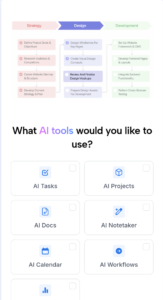
Motion isn’t just a calendar; it’s an AI orchestrator that handles tasks, projects, and your schedule in one view.” The “Automation Layer”: Building Your AI Employee
The most “future-proof” skill of 2026 is Workflow Orchestration. You shouldn’t
be moving data from your Email to your CRM or your Notion. An AI should do that.
Zapier Central is the leader here. It allows you to create “AI Agents” that live
across your apps.
- The Workflow: You can tell the AI: “Whenever a client emails me a frustrated message, summarizes their complaint, checks our previous contract in Dropbox,and drafts a polite reply in my Gmail drafts.”
- Why this ranks: It covers the keyword to automate daily tasks with AI by providing a specific, high-value example.

“Welcome to the era of the ‘AI Orchestrator’ where you spend your time on strategy while the AI manages the connections AI Time Management: Protecting Your “Focus Gold”
We only have about 3–4 hours of “Peak Brain Power” per day. AI time management
tools are designed to protect those hours like they are gold.
Tools like Endel or Brain.fm use AI to generate personalized “Focus Music” based
on your heart rate and the time of day. Meanwhile, apps like Freedom use AI to
predict when you’re most likely to get distracted by social media and block
those sites before you lose focus.
Future-Proofing: From “Hustle” to “System”
The 2010s were about “The Hustle.” The 2020s are about The System. The most
productive people in 2026 aren’t the ones working 80 hours a week. They are the
ones working 30 hours a week with an AI fleet doing the other 50 hours of work
in the background.
By implementing an AI Productivity Stack, you aren’t just saving time. You are
Reducing Decision Fatigue. You are saving your “Human Energy” for the things
that an AI will never be able to do: building relationships, creative strategy,
and high-level leadership.

“The future of work is clean, automated, and human-centric.” Frequently Asked Questions (FAQ)
Q: Is it safe to give an AI access to my calendar and email?
A: Most enterprise-grade tools like Motion and Zapier use SOC2 Type II security. They
don’t “read” your emails for fun; they scan them for “intent” and “dates” to
help you stay organized.
Q: Will AI productivity tools make me “lazy”? A: Only if you have no goals. If
you have big goals, AI doesn’t make you lazy; it makes you lethal. It removes
the “friction” between you and your achievements.
Q: What is the best free AI productivity tool? A: Otter.ai (for meeting notes)
and the free version of Perplexity are the best “entry-level” tools that provide
immediate value without a subscription.
Conclusion
The Sunday Scaries don’t have to be your baseline. They’re just a sign that your system needs an upgrade. To rise from the ashes.
Instead of putting in extra hours, the entrepreneurs who are quietly outperforming the hustle crowd have built an operating system that manages noise so they can attend to the tasks that genuinely need a human to steer the wheel. Ai has made these tasks so easy. Less reactive. More intentional. Always compounding.
Build the system once. Let it run. That’s not laziness, that’s leverage.