



You know the feeling. You hit submit, and somewhere in the back of your mind, you picture that Turnitin report loading the percentage creeping up, the highlighted sentences glowing orange and red like an accusation. For a lot of students right now, AI detectors have added a whole new layer of dread to that moment. And sometimes it says your text is AI generated even though we wrote everything by ourselves. And the fear makes sense.
The consequences are real.
But here’s what nobody is telling you clearly enough: the problem was never using AI. The problem is letting AI replace your thinking. Using AI to think is a skill but using AI to write is a trap. In this guide we will learn the skills of using our thinking and AI combined to do our job perfectly.
The Mindset Shift: Ghostwriter vs. Co-Pilot
The #1 reason students get caught by AI detectors in 2026 isn’t the technology, it’s the strategy. Most people use AI as a Ghostwriter: they give it a prompt and expect a finished essay to pop out. This is a trap. Not only is it easy to detect, but it’s also “mid-tier” work at best.
To be future-proof, you must treat AI as your Co-Pilot.
- Cognitive Offloading: Use AI to handle the “heavy lifting” of research, organizing data, and summarizing complex theories.
- Human Orchestration: You remain the “Conductor.” You decide the argument, you choose the tone, and most importantly, you write the final sentences.
The Golden Rule: If the AI is doing the thinking, you are cheating. If the AI is doing the organizing, you are innovating.
Understanding the Enemy: How AI Detectors Actually Work
To avoid being flagged, you need to understand what tools like Turnitin and GPTZero are actually looking for. They don’t “read” your essay; they look for two mathematical patterns:
- Perplexity: This measures how “random” your word choices are. AI is very predictable. Humans are weird. We use metaphors, we use slang, and we change our minds mid-sentence.
- Burstiness: This looks at sentence structure. AI tends to write sentences that are all the same length. Humans write “bursty” one long, descriptive sentence followed by a short, punchy one.
The Solution: Use the Human-in-the-Loop (HITL) method. Use AI to build your outline and find your sources. But when it comes time to write the draft, close the AI window. Write your thoughts in your own voice. Your natural “Human Chaos” is the best defense against a detector. After you have given the outline it becomes quite easier to write a piece of art out of it.
The “Citation Defense” Strategy
In 2026, the best way to prove you didn’t “cheat” is to show your work. This is where your NotebookLM setup (from our previous guide) becomes your greatest legal defense.
If a professor ever questions your paper, you don’t have to just say “I wrote it.” You can show them your Paper Trail:
- Source Grounding: Show them the notebook containing the 10 PDFs you researched.
- Inline Citations: Show how every major claim in your paper is backed by a specific page number from a real book.
- Version History: Always write in Google Docs or Microsoft Word. If accused, you can show the “Version History” which proves you spent five hours typing the paper, rather than copy-pasting it in five seconds.
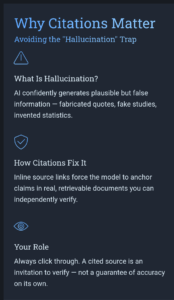
Your citations are your receipts. Always keep a record of where your information came from.” Avoiding the “Hallucination Trap”
There is something worse than being flagged for AI: being flagged for Falsification.
General AI models often “hallucinate” fake quotes or made-up statistics. If you turn in a paper with a fake citation, a professor will catch it instantly.
- The Fix: Never use a quote that a general chatbot gives you without verifying it. Use Consensus or Perplexity to find the real source.
- Fact: Students who use “Source-Grounded” AI see a 15% increase in citation accuracy and are significantly less likely to face disciplinary action.
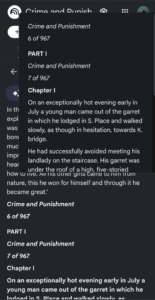
“Source-grounded tools like NotebookLM show you exactly where the facts are in the text, preventing dangerous hallucinations.” Building a Future-Proof Portfolio
The students who will go far ahead in the 2030s are the ones who can explain how they worked with AI to reach a conclusion. It’s a skill of its own to know how to use AI. On your resume, “I can use ChatGPT” is worthless. “I am an AI Orchestrator capable of managing complex research workflows” is a six-figure skill.
By following these ethical steps, you aren’t just staying out of the Dean’s office, you are training for the future of work.
Master the Full Workflow:
The Tools: See our [Ultimate Guide to AI Tools for Students 2026] for the list of ethical research assistants.
The System: Learn how to organize your “Paper Trail” in our [NotebookLM Deep Dive].
Frequently Asked Questions (FAQ)
Q: Can Turnitin see if I used AI for an outline?
A: Generally, no. AI detectors are trained to find AI-generated prose (full sentences and paragraphs). If you use AI for the outline but write the sentences yourself, your “Voice” will be 100% human.
Q: Is “Paraphrasing” AI-generated text safe?
A: It’s risky. Many “Paraphrasing” tools just swap words, but the underlying “pattern” (the Perplexity) often stays the same. It is much safer to read the AI’s idea and then explain it out loud to yourself before writing it down.
Q: What should I do if I am falsely accused of using AI?
A: Don’t panic. Bring your “Paper Trail.” Show your Google Docs version history, your research notes in NotebookLM, and the physical books or PDFs you used. Accurate citations are the ultimate “Get Out of Jail Free” card.
Conclusion
Using AI ethically, as it should be, isn’t just the safe choice, it’s the smartest way to be a student in 2026. You definitely need the use of AI any now and then. So, the goal was never to let a machine think for you. The goal is to use these tools to become a sharper, more confident thinker yourself.
You now have everything you need. Check out our other two guides, the best AI tools for students and our NotebookLM deep dive to complete your study setup. Go in prepared, go in honesty, and good luck with your exams. You’ve got this.